Gods of Jade and Shadow by Silvia Moreno-Garcia

Synopsis:


The Jazz Age is in full swing, but Casiopea Tun is too busy cleaning the floors of her wealthy grandfather’s house to listen to any fast tunes. Nevertheless, she dreams of a life far from her dusty small town in southern Mexico. A life she can call her own.

Yet this new life seems as distant as the stars, until the day she finds a curious wooden box in her grandfather’s room. She opens it—and accidentally frees the spirit of the Mayan god of death, who requests her help in recovering his throne from his treacherous brother. Failure will mean Casiopea’s demise, but success could make her dreams come true.

In the company of the strangely alluring god and armed with her wits, Casiopea begins an adventure that will take her on a cross-country odyssey from the jungles of YucatΓ‘n to the bright lights of Mexico City—and deep into the darkness of the Mayan underworld.


Rating: 🌟🌟🌟


If you loved Naomi Novik's Uprooted or Spinning Silver, you have to read this.

Objectively, this is an excellent novel. It's got mythology you likely haven't read about before, a quietly lovable heroine, and intense fairy tale vibes. In a sea of retellings, Gods of Jade and Shadow stands out as something fresh and unique. However, I just couldn't jive with the writing of this novel and so, while I enjoyed it, I didn't love it.

One of my favorite aspects of this novel was the history and mythology. I've never read a novel set in 1920's Mexico, and so a lot of the folklore surrounding the story was entirely new to me. Because of that, the story and setting felt very original to me personally. The 1920's setting added an interesting juxtaposition between the ancient and the modern, and I liked seeing how gods and demons adjusted - or didn't - to the presence of technology. Additionally, Silvia Moreno-Garcia set the scene at the beginning of most chapters by giving a brief history of the areas Casiopea travels to, which I really enjoyed. I'm not nearly as familiar with Mexican history and mythology as I'd like to be, so it gave me needed context that only enhanced my reading experience.

Where the book didn't work for me was in the writing and type of story. The writing is fairly blunt and doesn't rely much on sensory detail to tell the story. Instead, Moreno-Garcia is the type of writer that paints a picture for you, rather than has you experience it. I think this writing style enhanced by the folklore vibes, but as someone who prefers sensory writing to picturesque writing, it made me have a hard time losing myself in the story, and thus connecting with the characters.

I also found the story itself to be kind of boring. Gods of Jade and Shadow is a journey narrative, and I don't tend to enjoy journey narratives. The events usually feel too random and disjointed to engage me, and this novel was no different.

Ultimately, my 3 star rating of this book comes down to personal enjoyment more than anything else. If you don't have an issue with journey narratives or specific writing tastes, I reckon you'll thoroughly enjoy this. 


 ARC provided by Penguin Random House via Netgalley in exchange for my honest thoughts and review.

A Curse So Dark and Lonely (A Curse So Dark and Lonely, #1) by Brigid Kemmerer

Synopsis:


Fall in love, break the curse.

Cursed by a powerful enchantress to repeat the autumn of his eighteenth year, Prince Rhen, the heir of Emberfall, thought he could be saved easily if a girl fell for him. But that was before he turned into a vicious beast hell-bent on destruction. Before he destroyed his castle, his family, and every last shred of hope.

Nothing has ever been easy for Harper. With her father long gone, her mother dying, and her brother constantly underestimating her because of her cerebral palsy, Harper learned to be tough enough to survive. When she tries to save a stranger on the streets of Washington, DC, she's pulled into a magical world.

Break the curse, save the kingdom.

Harper doesn't know where she is or what to believe. A prince? A curse? A monster? As she spends time with Rhen in this enchanted land, she begins to understand what's at stake. And as Rhen realizes Harper is not just another girl to charm, his hope comes flooding back. But powerful forces are standing against Emberfall . . . and it will take more than a broken curse to save Harper, Rhen, and his people from utter ruin.


Rating: 🌟🌟🌟


3.5 stars. I was really excited for this, but it ended up being a pretty standard YA fantasy. This probably would've been a ~2 star book for me if not for two things: the cerebral palsy rep and Grey.

I hate to say it, but this is the first book I've read that depicts cerebral palsy. I've never read a book with cerebral palsy rep in it until now. And that is a damn shame. Because while I don't have cerebral palsy, I do have two degenerative, herniated discs in my back that cause me chronic pain and weakness. Seeing Harper embrace her condition and realize that it doesn't define her, but is simply a part of her really spoke to the core of me and my experiences. This novel could have very easily taken the route of Harper "overcoming" her cerebral palsy - which would've been fine I guess while still having issues - but it wouldn't have rung as true, nor have had as powerful an impact on me. Harper becomes a badass in harmony with her cerebral palsy, not despite it, and having that narrative depicted in YA is so important.

The second thing that made me really enjoy this book was GREY!!! Heart eyes directly @ him, honestly. In a YA fantasy that features pretty stereotypical characters for the genre, Grey alone stood out as unique to me. I did like Harper as a character, but I feel like I enjoyed the depiction of her cerebral palsy and character arc as a result of it more than I actually liked her as a character. Rhen I didn't really care for, as a result of him being really cookie-cutter YA fantasy love interest. But Grey, with his to-death dedication and stony demeanor, felt really original to me. He was hard to pin down and I could never call how he was going to react to things, which naturally made me more interested and invested in him than the other characters. I'm really looking forward to seeing more of him in the next book.

But other than that, A Curse So Dark and Lonely doesn't really bring anything new to YA fantasy. You've got your badass girl, your arrogant yet tortured princely love interest, a kingdom in peril that needs to be reclaimed...sound familiar? The events of the book itself weren't anything especially stand-out and honestly edged on boring sometimes. The world-building doesn't really exist and is superficial at best. Even the plot twist was something that I called from a mile away.

Overall, I enjoyed A Curse So Dark and Lonely, but only because it brings in a new element or two to an otherwise really standard and kind of bland YA fantasy. However, I encourage you to read it if only for the cerebral palsy rep, because as someone who doesn't have cerebral palsy but similar experiences with chronic pain and weakness, its portrayal meant a lot to me.

Spin the Dawn (The Blood of Stars #1) by Elizabeth Lim

Synopsis:


Maia Tamarin dreams of becoming the greatest tailor in the land, but as a girl, the best she can hope for is to marry well. When a royal messenger summons her ailing father, once a tailor of renown, to court, Maia poses as a boy and takes his place. She knows her life is forfeit if her secret is discovered, but she'll take that risk to achieve her dream and save her family from ruin. There's just one catch: Maia is one of twelve tailors vying for the job.

Backstabbing and lies run rampant as the tailors compete in challenges to prove their artistry and skill. Maia's task is further complicated when she draws the attention of the court magician, Edan, whose piercing eyes seem to see straight through her disguise.

And nothing could have prepared her for the final challenge: to sew three magic gowns for the emperor's reluctant bride-to-be, from the laughter of the sun, the tears of the moon, and the blood of stars. With this impossible task before her, she embarks on a journey to the far reaches of the kingdom, seeking the sun, the moon, and the stars, and finding more than she ever could have imagined.


Rating: 🌟🌟🌟


3.5 stars. Spin the Dawn started off as a 5 star read for me. I'd been in a bit of a reading slump prior to starting this but right off the bat, this book had me hooked. I loved the writing, the world, the characters - everything! I read about half of the book in one sitting, because I just couldn't put it down.

Writing is always what makes or breaks a novel for me. Because YA tends more towards simplistic prose than its adult counterparts, I often end up dnfing YA books because I can't get into the writing. But as soon as I started reading, I knew Elizabeth Lim was a skilled writer. Her lush descriptions and interesting language is what pulled me into the story before anything else did. Only 3% of the way into the novel and I was already loving it, simply because the language on the page was so lovely.

Though the writing itself initially drew me in, one of my favorite tropes is competition stories, and so I expected the tailor competition to entice me right away. But, surprisingly, it was the characters. I was anticipating a reality TV-type competition, full of drama and beautiful clothes - and was totally wrong. The competition was pretty reserved, if I'm being honest. But seeing Maia's courage, skill, and determination as she tried to navigate the competition and become the emperor's tailor made me root for her. She wasn't just a vehicle for drama during the competition, like other characters have been in other competition-focused series. Lim takes the focus off the competition and puts the spotlight on Maia, which is something I haven't seen much before.

During the competition, several other characters orbit Maia, mainly the Lord Enchanter, Edan, and the emperor's betrothed, Lady Sarnai. Both remained very unpredictable characters for me in the first half of the novel, which was really refreshing to me, as a person who tends to call the twists before they happen. Lady Sarnai, especially, was a hard character to nail down. Whenever I thought I knew how she'd react to something, she'd do the exact opposite and always kept me on my toes.

As for Edan, it's established early on in the novel that he's much older than he looks. I have trouble with the believability of immortal/long-lived characters in YA sometimes, due to their young behavior or way of speaking. But the way Edan spoke and acted felt unnatural to a 20-year-old to me, and I loved it. I felt the weight of his years on him, despite his young looks. He was so enigmatic that it made him all the more alluring to me.

But while I was so completely engrossed by the first 60% of this novel, the second half is where things started to go downhill for me. The novel shifts in a very different direction than the first half, from court intrigue to a journey narrative. I don't tend to be a fan of "road trip" stories, but I think Spin the Dawn could've convinced me, seeing as how much I loved the first half. Unfortunately, it didn't.

In the first half of the novel, there's such a delicious build-up to the romance between Maia and Edan. Unlike a lot of other YA, which rushes into insta-love so quickly your neck still aches days later from the whiplash, the romance in the first half of Spin the Dawn builds so quietly and sweetly - to the point where I couldn't guess who the love interest was at first, which almost never happens to me. But as soon as Maia and Edan start getting their flirt on, they rush into romance so quickly that it becomes an avalanche and the plot in the second half simply can't recover from it.

My biggest problem with the second half of this book is that everything hinges on the romance. Unlike the first half, which focuses on Maia's personal goals and love for her family, her entire life becomes consumed by her overwhelming love for Edan. And because Spin the Dawn becomes another YA fantasy with a romance-centered plot, the stakes had no weight behind them because I knew that everything would mostly turn out all right until the climax. I've read this type of YA story many times before. In the second half of the novel, Spin the Dawn lost all of its unpredictability for me and became a much less engaging read.

However, I would like to acknowledge that though I personally wish the second half of the novel was more unique, I also realize the importance of telling stories written by and featuring characters of color with tropes already explored by white authors. Just because a trope has been written over and over by white writers doesn’t mean its “overdone” when written by marginalized authors.

Overall, I have really mixed feelings on this book. It’s a 5 star beginning coupled with a 2 star ending. Spin the Dawn starts off with gorgeous writing, unpredictable and engaging characters, and slow-building romance, but unfortunately loses sight of its plot and characters in favor of romance in the second half. Should you still read it? Yes, if only because the beginning is such a winner.


ARC provided by Random House Children's via Netgalley in exchange for my honest thoughts and review.

An Enchantment of Ravens by Margaret Rogerson

Synopsis:


Isobel is a prodigy portrait artist with a dangerous set of clients: the sinister fair folk, immortal creatures who cannot bake bread, weave cloth, or put a pen to paper without crumbling to dust. They crave human Craft with a terrible thirst, and Isobel’s paintings are highly prized. But when she receives her first royal patron—Rook, the autumn prince—she makes a terrible mistake. She paints mortal sorrow in his eyes—a weakness that could cost him his life.

Furious and devastated, Rook spirits her away to the autumnlands to stand trial for her crime. Waylaid by the Wild Hunt’s ghostly hounds, the tainted influence of the Alder King, and hideous monsters risen from barrow mounds, Isobel and Rook depend on one another for survival. Their alliance blossoms into trust, then love—and that love violates the fair folks’ ruthless laws. Now both of their lives are forfeit, unless Isobel can use her skill as an artist to fight the fairy courts. Because secretly, her Craft represents a threat the fair folk have never faced in all the millennia of their unchanging lives: for the first time, her portraits have the power to make them feel.


Rating: 🌟🌟


I really wanted to love this. Despite going in with low expectations, I still came out disappointed. More than anything, I think this book has a lot of missed potential because it's too short. I was drawn in immediately by the writing, characters, and setting, but those quickly got sacrificed in order to rush through the plot in the small amount of page space.

This book's biggest downfall is that it's not longer. It clocks in at 297 pages, which just simply isn't enough for a fantasy story that is driven primarily by love. If there had been even 100 extra pages, I think the romance would've felt more fleshed out and the main antagonist more present earlier in the story. But because this story didn't have that extra space, An Enchantment of Ravens is plagued by insta-love and an ending that doesn't have any weight because the antagonist was introduced in the last 50 pages.

The insta-love was definitely the most harmful aspect to this book for me. Unlike other YA fantasies, where the romance is a subplot to the main plot, the story of An Enchanment of Ravens hinges completely on the romance between Isobel and Rook. Even if in other YA fantasies, the romance overwhelms what's actually happening in the main plot, a main plot still exists outside of the romance. In this book, all of the stakes and consequences are derived from the romance. The characters are only in peril because of their love. And so when we don't actually get to see that love develop on the page beyond a few scenes of the characters interacting, the whole story just feels hollow.

I'm also personally just not into journey books. I usually find them meandering and kind of boring. The synopsis set me up for court intrigue, which I love, and instead I ended up with a journey narrative. I would've reconsidered picking up this book, had I known half of it would've been a journey story.

Overall, An Enchanment of Ravens falls flat because of its short length. Margaret Rogerson is a good writer and has interesting ideas, but the length of this novel just did not do the story Rogerson wanted to tell justice.

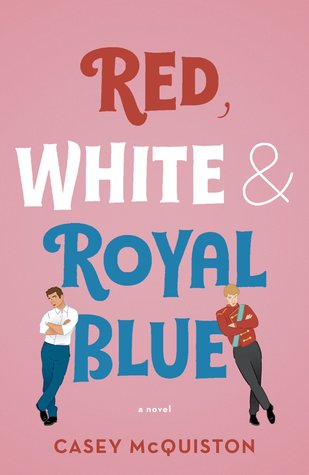
Red, White & Royal Blue by Casey McQuiston

Synopsis:


First Son Alex Claremont-Diaz is the closest thing to a prince this side of the Atlantic. With his intrepid sister and the Veep’s genius granddaughter, they’re the White House Trio, a beautiful millennial marketing strategy for his mother, President Ellen Claremont. International socialite duties do have downsides—namely, when photos of a confrontation with his longtime nemesis Prince Henry at a royal wedding leak to the tabloids and threaten American/British relations.

The plan for damage control: staging a fake friendship between the First Son and the Prince. Alex is busy enough handling his mother’s bloodthirsty opponents and his own political ambitions without an uptight royal slowing him down. But beneath Henry’s Prince Charming veneer, there’s a soft-hearted eccentric with a dry sense of humor and more than one ghost haunting him.

As President Claremont kicks off her reelection bid, Alex finds himself hurtling into a secret relationship with Henry that could derail the campaign and upend two nations. And Henry throws everything into question for Alex, an impulsive, charming guy who thought he knew everything: What is worth the sacrifice? How do you do all the good you can do? And, most importantly, how will history remember you?


Rating: 🌟🌟🌟🌟🌟


ARC provided by St. Martin's Press via Netgalley in exchange for my honest thoughts and review.

You know how, in the original animated How the Grinch Stole Christmas, at the end of the film the Grinch's heart grows three sizes and he's filled with overwhelming love and affection? ME WHILE READING THIS BOOK.

Queer rep in this: biracial (Mexican/white) bisexual man, white gay man, bisexual woman, Latino gay man, Asian transwoman with a wife, and a pansexual man. And that's what's just on the page - there are at least two other characters I can think of that I suspect are queer. (Yes, I also just about died seeing such a variety of queer folks on the page.)

I cannot even begin to express how deeply I loved this book. It made my cold, shriveled heart feel things. It had me laughing harder than any novel has in a long while. But most of all, it gave me hope during a time in U.S. history where hope is such a difficult thing to hold on to. Do not doubt how self-aware this book is about how race, sexuality, and gender interact with politics, especially in the U.S..

The characters in this are so insanely lovable. Alex and Henry are such realistic, well-written characters in their own right, but together? They were so sweet they made my teeth ache, oh my goodness. I adored every single step of their relationship and I felt their emotions right there with them. Honestly, this book probably has the most realistic, healthiest portrayal of a hate-to-love relationship I've ever read. I flippin' loved it, y'all.

But even though Alex and Henry are the main show, I literally loved every single character??? June, Nora, and Bea especially, but I have to give a shoutout to Zahra. Just about every sentence that came out of Zahra's mouth had me screaming with laughter. Each female character in this novel is really complex and well-fleshed out, even if they have less screen time in comparison to Alex and Henry.

I don't tend to read a lot of voice-heavy novels - probably a result of reading too many fantasy novels - but I a b s o l u t e l y l o v e d the voice of Red, White & Royal Blue. It was so millennial in tone, and I say that unironically. I've never felt more seen in how my peers and I communicate. Casey McQuiston's writing is clever and existential and laugh-out-loud funny. I'm lucky I was able to read this exclusively in the comfort of my own home, because otherwise I would've been that one person silently heaving in public, red-faced from trying to choke my laughter down.

The pacing in this was also really well done. Pacing tends to be an issue I see often in novels, but McQuiston makes it seem effortless. You feel the months of time passing, beyond the text telling you that time has gone by. It makes the progression of Alex and Henry's relationship feel really organic. Insta-love? We don't know her. Also because of how great the pacing was, this novel felt like it had SO MUCH packed into it. When I was halfway done, I couldn't believe I was ONLY half-way done - that's how much was happening on the pages. Yet despite having so much content, never at any point did I feel like anything in this book was rushed. Every single scene felt necessary and exactly the length it needed to be.

By far, this book brought me more unbridled joy than anything I've read in recent memory. Casey McQuiston has become an auto-buy author for me, hands down.

My suggestion to you? Go pre-order this book. Go make a suggestion to your local library to purchase this book. Go put a hold on this book at your local library, so you can love it on release just as much as I did. If you're queer or support queer people, go shout about this book from the rooftops because I promise, this is the type of queer book queer readers have been waiting for.

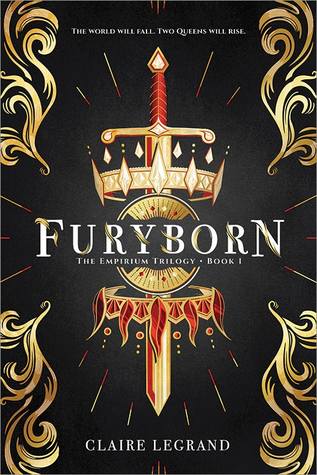
Furyborn (Empirium, #1) by Claire Legrand

Synopsis:


When assassins ambush her best friend, Rielle Dardenne risks everything to save him, exposing herself as one of a pair of prophesied queens: a queen of light, and a queen of blood. To prove she is the Sun Queen, Rielle must endure seven elemental magic trials. If she fails, she will be executed...unless the trials kill her first.

One thousand years later, the legend of Queen Rielle is a fairy tale to Eliana Ferracora. A bounty hunter for the Undying Empire, Eliana believes herself untouchable--until her mother vanishes. To find her, Eliana joins a rebel captain and discovers that the evil at the empire's heart is more terrible than she ever imagined.

As Rielle and Eliana fight in a cosmic war that spans millennia, their stories intersect, and the shocking connections between them ultimately determine the fate of their world--and of each other.


Rating: 🌟🌟🌟🌟


4.5 stars. Oh my goodness, I flipping loved this! Imagine the addictive quality and vibe of a Sarah J. Maas book, but with queer characters, characters of color, more cohesive world-building, and a narrative beyond romance, and you get Furyborn.

Gosh, where do I even start? What drew me in with this novel initially was the SJM vibe. I used to love SJM's books, despite all their faults and problematic elements, but there has been a noticeable decline in the quality of her works in the past few years. I just can't get into her books like I used to, and I feel really disillusioned with her new works. I've been mourning it, honestly, the loss of these addicting, guilty pleasure reads. So discovering Furyborn as a comparable, but distinctly better, work was such a delight. My feelings for this book went from zero to 100 REAL QUICK.

One of my favorite parts about this book was the world-building. I can't believe I'm saying this, but in an age of YA fantasy where belief typically takes the form of a pantheon consisting of multiple gods, Furyborn's obvious inspiration from Christian mythology was really refreshing. Typically, portions of Christian myth are cherry-picked - angels as ~cool supernatural beings~ or religious Renaissance art aesthetic, for example - and slapped into a fantasy world without context. But in the world of Furyborn, there is/was a God with a capital G. And that's something I've never seen in a modern fantasy novel. Angels are ultimately the focus of this world and their existence is cohesive with the world-building, rather than just being an intriguing, powerful fantasy race. I loved that continuity.

In terms of the characters, I have mixed feelings. Both Rielle and Eliana can be intensely unlikable characters at times. There were times were I was ready to jump out of my seat and root for them, and other times their foolishness had my eyes rolling so far into the back of my head. Eliana is such a hard ass that I think she's a difficult character to write, so her characterization sometimes felt inconsistent and unbalanced in those moments of vulnerability. Rielle definitely felt more constant. But despite their flaws, I LOVED these two women. I adore heroines that aren't easy to love with my entire soul.

Plus, they're both bisexual! I know some have had some issues with the bi rep in this book, but as a bisexual woman, I absolutely loved reading about two amazing, complicated, powerful bi women. Acting like a bi women is suddenly "not bisexual enough" if she's in a relationship with or attracted to the opposite gender is frankly biphobic and if you feel that way, I strongly encourage you to rethink your attitude towards bi folks. I think critiques regarding the "promiscuous bisexual" stereotype are valid, though, even if I personally don't think this novel is enforcing that. Thanks for coming to my TED talk.

Also, Corien. That's it. That's the entire paragraph.

Okay, no, but I freaking loved Corien. 11/10 Claire Legrand did an amazing job at writing him. He's a bastard, but I haven't been so intrigued by a character since the Darkling. If you think I was Rielle every time Corien spoke to her...you so right. I enjoyed Simon a lot too, but like Rielle, I thought he suffered uneven characterization towards the end of the novel.

The pacing wasn't the best at times, but switching between queens every single chapter was such a smart strategy on Legrand's part in keeping me engaged. Almost every chapter ended on a cliffhanger. So when I was just about bursting with excitement for Rielle's journey, suddenly a new chapter would begin following Eliana. But then by the time I would get to the end of Eliana's chapter, I'd be so engrossed in her story that switching back to Rielle would be difficult. It kept me consistently excited for both Rielle's and Eliana's stories, so I never favored one storyline over the other and it made the pages fly by.

So now that we've established that MY ENTIRE BODY SANG WITH LOVE THE WHOLE TIME I READ THIS, why isn't this a 5 star read? What it comes down to is that I didn't enjoy the last 1/3 of the book as much as I did the first 2/3. Eliana's chapters felt especially meandering towards the end of the novel, and I still don't understand what Navi or Remy are contributing to the story besides convenient outlets for character development that doesn't feel organic. That, combined with Eliana and Simon's uneven characterization, made the last bit of the novel significantly less exciting for me. I have a feeling my rating will change to 5 stars on a reread, but for now, Furyborn is a 4.5 for me.

If you got this far, my advice is this: If you loved Throne of Glass, read this. If you hated Throne of Glass, read this.

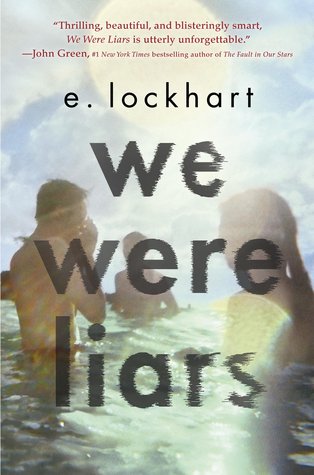
We Were Liars by E. Lockhart

Synopsis:


A beautiful and distinguished family.
A private island.
A brilliant, damaged girl; a passionate, political boy.
A group of four friends—the Liars—whose friendship turns destructive.
A revolution. An accident. A secret.
Lies upon lies.
True love.
The truth.

We Were Liars is a modern, sophisticated suspense novel from New York Times bestselling author, National Book Award finalist, and Printz Award honoree E. Lockhart.


Rating: 🌟🌟


I think I would've enjoyed this a lot more had my expectations been different. Between the vague synopsis and "mind-blowing" twist everyone always talks about, I was anticipating a mystery thriller about a bunch of spoiled rich kids on a private island doing scandalous things. Instead, this is a slow-moving mystery about a girl with amnesia wandering around her family's private island. Because of my wrong expectations, I was a bit bored with the story overall.

But let's talk about the things I liked first. The writing in this is gorgeous. I understand why its not some people's jam, but I adore well-done purple prose and E. Lockhart is undeniably a skilled writer. The beautiful prose really helped carry me forward through the novel, because even if I was bored with the story, I loved the images I was experiencing. However, I do think Lockhart did take metaphors a bit too far in places, especially in the beginning of the novel when Cady says her father shot her in the heart when he leaves. It took me a moment to realize he didn't literally shoot her and Lockhart meant these moments of her being wounded as metaphors.

Because Lockhart is a such a strong writer, I thought she did a really fantastic job of setting the atmosphere for this story. Everything felt so surreal, it made me feel really uneasy and unsettled. Obviously I knew there was a big twist coming based off of reviews, but if I hadn't, the novel's tone definitely made me feel like something was very wrong and something huge was about to happen.

But that's about all I enjoyed.

Without getting into any spoiler territory, I was severely letdown by the plot twist and it honestly tainted the entire book for me. Instead of shocking me, it just made me sad and disgusted, which was amplified by how sensory the writing was. I really wasn't sure what direction the novel would take, but the plot twist was one of several guesses I had, so it had less impact on me. Plus, I didn't really care about any of the characters, including Cady.

But ultimately, what disappointed me most was how much potential this novel had to critique the wealth gap between the white elite and people of color in the U.S., and its failure to do so. With all the little hints of critical thought littered throughout the novel, I really believed that was the direction it would take. I thought this was leading to a Get Out scenario, only in book form. But it didn't, and I'm really sad about it.

Overall, I think this novel has gorgeous prose and a carefully cultivated atmosphere, but fails to deliver a satisfying twist due to bland characters and missed potential to talk about important issues.

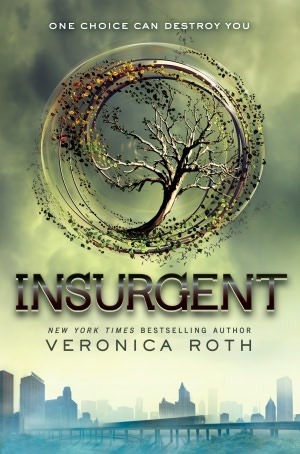
Insurgent (Divergent, #2) by Veronica Roth

Synopsis:


One choice can transform you—or it can destroy you. But every choice has consequences, and as unrest surges in the factions all around her, Tris Prior must continue trying to save those she loves—and herself—while grappling with haunting questions of grief and forgiveness, identity and loyalty, politics and love.

Tris's initiation day should have been marked by celebration and victory with her chosen faction; instead, the day ended with unspeakable horrors. War now looms as conflict between the factions and their ideologies grows. And in times of war, sides must be chosen, secrets will emerge, and choices will become even more irrevocable—and even more powerful. Transformed by her own decisions but also by haunting grief and guilt, radical new discoveries, and shifting relationships, Tris must fully embrace her Divergence, even if she does not know what she may lose by doing so.


Rating: 🌟🌟🌟


Part of what made Divergent so enjoyable was its fast pace. Despite being over 400 pages long, Tris's journey to become Dauntless is so engaging it flies by. In Insurgent, pretty much everything I loved about Divergent goes away: the fast pace, the captivating competition, the slow burn romance, and Tris's rise from the underdog. I get why Insurgent plays out the way it does, but that doesn't make it enjoyable.

Insurgent's biggest flaw is that it tries to base its plot on the mysteries of its world, but it's world-building is a mess. You can't have the crux of a story rest on a world that doesn't make sense. Unlike The Hunger Games trilogy, which has a believable and well-developed dystopian world, the Divergent trilogy is more aesthetically dystopian than actually dystopian in setting. So when you try to turn your aesthetic into a 500+ page rebellion plot, it just doesn't work.

Now, there is some good stuff in there. Tris's survivor's guilt is totally warranted after what she went through in the events of Divergent, but ultimately fails to be believable because the pacing of Insurgent is so poor. Months are supposed to be passing in this book, but if I wasn't reading closely and you asked me, I would've said two weeks. Because of that, Tris's 180 in character and conflict with Tobias as a result feels jarring. Simply put, Tris didn't at all feel like the sixteen-year-old brutal badass I fell in love with in the first book. And Tobias, who I was swooning over in Divergent? Literally could not care less about him or his relationship with Tris in this book.

Also, nothing really happens in Insurgent? Despite months passing? In a 500+ page book? Tris goes to some places, bullets are fired, she cries and fights with Tobias, and then the book ends with you more confused than ever about what the heck this world-building is supposed to be because this ain't it chief.

Similar to my star rating for Divergent, objectively I would say this is a 2 star read. But I did legitimately enjoy it - both in terms of nostalgia and because I expected it to be waaaay worse - so I'm giving it a 3 stars.

Divergent (Divergent, #1) by Veronica Roth

Synopsis:


In Beatrice Prior's dystopian Chicago, society is divided into five factions, each dedicated to the cultivation of a particular virtue--Candor (the honest), Abnegation (the selfless), Dauntless (the brave), Amity (the peaceful), and Erudite (the intelligent). On an appointed day of every year, all sixteen-year-olds must select the faction to which they will devote the rest of their lives. For Beatrice, the decision is between staying with her family and being who she really is--she can't have both. So she makes a choice that surprises everyone, including herself.

During the highly competitive initiation that follows, Beatrice renames herself Tris and struggles to determine who her friends really are--and where, exactly, a romance with a sometimes fascinating, sometimes infuriating boy fits into the life she's chosen. But Tris also has a secret, one she's kept hidden from everyone because she's been warned it can mean death. And as she discovers a growing conflict that threatens to unravel her seemingly perfect society, she also learns that her secret might help her save those she loves . . . or it might destroy her.


Rating: 🌟🌟🌟🌟🌟


Objectively, this is a 3 star book. But this was my favorite book when I was 14 and remained so for much of high school, and so my nostalgic ass is giving this 5 stars.

With how much dislike Divergent has gained over the years, I expected the worst. Insta-love, terrible writing, bland "badass" heroine, the works. But Divergent isn't actually that bad. Is it the best example of YA literature? No, not at all. But I've endured a lot of bad YA, and to lump Divergent in with those works is an insult to what is an engaging read with a frankly brutal heroine.

Tris really surprised me. I expected her to have no personality and y'all, I couldn't have been more wrong. In an age of bland YA fantasy heroines, Tris is harsh, unlikable, and willing to fight literally everyone for the people she loves. So naturally, I loved her. I love anti-heroines and honestly, Tris was an anti-heroine before Jude Duarte or Mia Corvere were even a glimmer in their authors' minds. Tris is silenced, beaten, and sexually assaulted over the course of this novel, and turns herself into a weapon as a result of her trauma. She can be terribly selfish and dumb at times, but these flaws and mistakes make her feel real and, best of all, human. I'm so sad that Tris became so hated over the years when she's actually a well-developed character.

FYI, there's no insta-love in this. I sincerely loved Tris's relationship. Nowadays, most relationships in YA novels feel like a necessary evil to me, so it was really refreshing to read about a slow-building relationship based on mutual trust, rather than the immediate lust that drives a lot of YA today.

Training montages and competitions are two of my favorite tropes in books, so Divergent was especially thrilling and engaging to me. Tris's Dauntless training was actually a lot darker than I remember it being, which I appreciated as an adult reader. There isn't really much plot besides Dauntless training for the majority of the book, but I was totally okay with that due to my tastes.

Now let's get into the bad stuff. Eight years later, the world-building still doesn't make any sense. It's fine if you catch a glimpse at it from your periphery, but as soon as you look at it head-on, it just collapses. You've really got to suspend your disbelief with this world. The world, more than anything, is an aesthetic choice.

Overall, I'm really glad I reread this. Divergent doesn't measure up to the same quality we get from a lot of YA today, but we sell it too short nowadays for what it is: a gripping page-turner with a brutal heroine against a dystopian aesthetic backdrop. I unapologetically love Divergent.

One Word Kill (Impossible Times, #1) by Mark Lawrence

Synopsis:


In January 1986, fifteen-year-old boy-genius Nick Hayes discovers he’s dying. And it isn’t even the strangest thing to happen to him that week.

Nick and his Dungeons & Dragons-playing friends are used to living in their imaginations. But when a new girl, Mia, joins the group and reality becomes weirder than the fantasy world they visit in their weekly games, none of them are prepared for what comes next. A strange—yet curiously familiar—man is following Nick, with abilities that just shouldn’t exist. And this man bears a cryptic message: Mia’s in grave danger, though she doesn’t know it yet. She needs Nick’s help—now.

He finds himself in a race against time to unravel an impossible mystery and save the girl. And all that stands in his way is a probably terminal disease, a knife-wielding maniac and the laws of physics.

Challenge accepted.


Rating: 🌟🌟🌟 


PSA: One of the main characters is a bisexual girl and another is a gay boy of color. Don't sleep on this one y'all!!!

I truly believe that Mark Lawrence can't write a book that is anything short of excellent. That being said, however, I'm not always the right audience for every single one of Mark Lawrence's books. I think One Word Kill is going to be the book for a lot of people, but it wasn't for me. So while objectively I can say this is a really fantastic novel, personally I enjoyed it but didn't love it.

Despite the Stranger Things vibes of this, One Word Kill is undoubtedly original and unique. A lot of times, whenever a book is similar to something else, it usually means it's a less good version of the original thing. But this novel stands firmly on its own feet. Besides the 80s setting and cast of young teens, One Word Kill is nothing like Stranger Things in terms of characters and content. So if you like Stranger Things, there's no doubt in my mind that you'll adore this.

Probably my favorite thing about this novel was how Lawrence challenged the views Nick had been socialized to hold by his predominantly white and straight all boys school. Nick reads exactly like how you'd expect a teenage boy to sound, including all the problematic views surrounding women, race, and LGBT+ people. But whenever Nick expressed one of these views, he was shut down by either his friends or himself and then educated or reflected on why his thoughts or behaviors were hurtful. To me, this was some of the most important character growth I've ever seen a teen boy protagonist undergo. Mind you, all of these moments were little moments and didn't hinder or affect the plot at all, but it means a lot to me that Lawrence felt they were important enough to include not just once, but several times.

While overall I think the story of this novel is strong, I have very mixed feelings about the villain. The main cast of boys and Mia are so wonderfully distinct and fleshed out, whereas the villain was just evil and didn't have much of a personality beyond that. It also makes me uncomfortable that the villain seemed to be characterized as evil because of his "craziness," without any explanation as to what that means. Is mental illness affecting his actions? Is he just selfish and mean? I wish the villain had had a clearer motivation for his actions because otherwise, it forces the reader to believe the main characters calling him "crazy" or "psycho" and paints a really stigmatizing and problematic view of mental illness, if the villain is mentally ill at all. However, Mark Lawrence is very obviously trying to write diversely and comment on issues surrounding marginalized identities, so I trust that he'll listen to feedback and improve in his future works.

Overall, this was a great book with lovable characters and a cool plot. I didn't love it, but I will definitely be reading the sequel!